Assalamualaikum. First let me introduce myself, my name is Nurin Amirah Atiqah binti Nor Akmazaki. I come from Kluang, Johor. I’m just being one of the undergraduate in Diploma in Office Management at Uitm Campus Alor Gajah Melaka. I’m so grateful to being part of Uitm student. Why I’m choosing BA118 course is because it was one of the interesting course. Before I choose this course I have make some research what was office management was about. So according tohttps://en.wikipedia.org/wiki/Office_management. Office management is a profession involving the design, implementation, evaluation, and maintenance of the process of work within and office or other organization, in order to sustain and improve efficiency and productivity. I’m doing this blog is to introduce about UED 102. It was the first subject I was learn on my first period as uitm student. UED 102 is about study skills also known as soft-skills. This course expose students to effective time management, setting goal, learning style and processing information from lecturers.
..
topic :
NO
Topic
Content for portfolio
1.
Getting ready to learn.
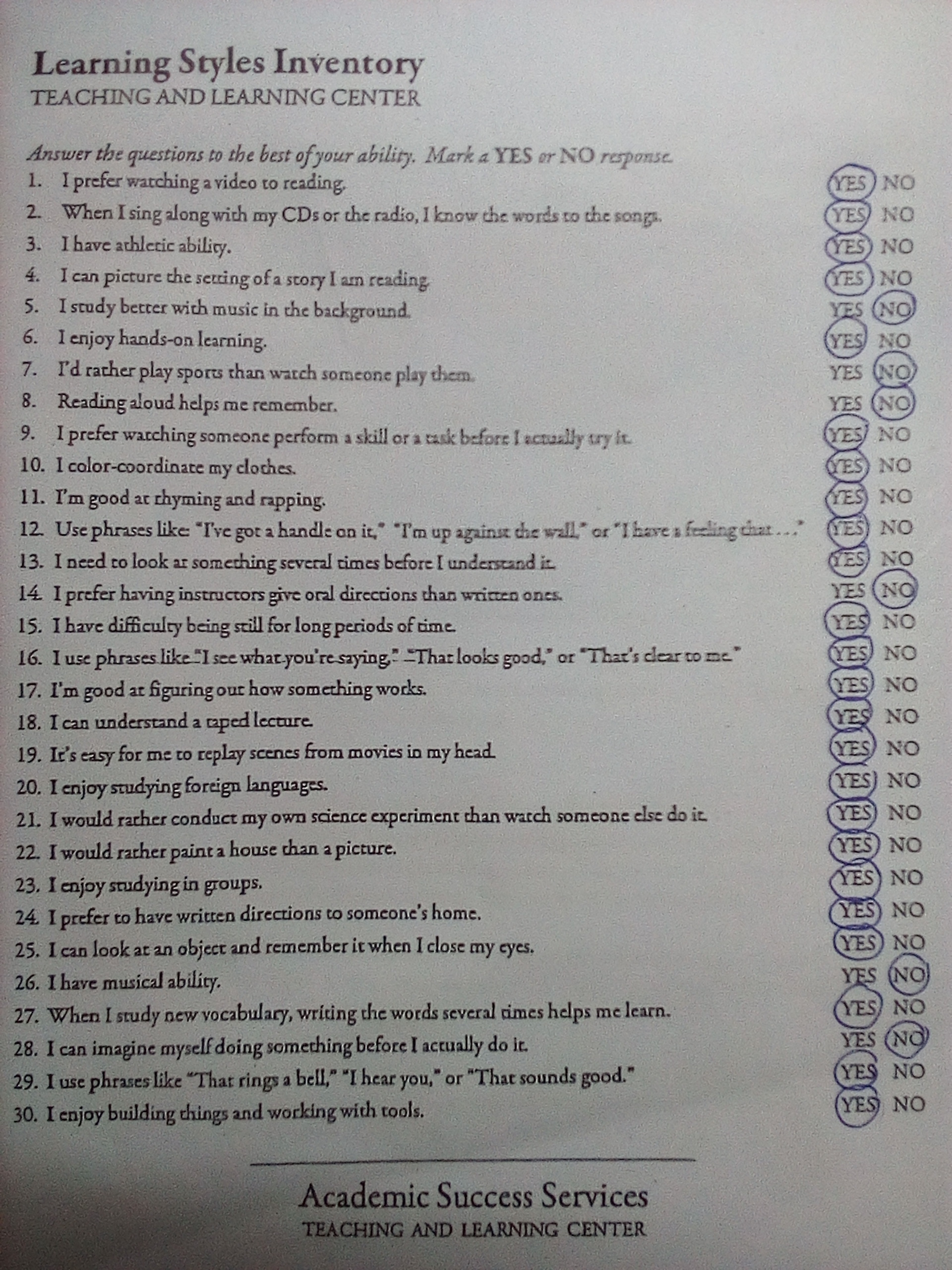
Learning style inventory
2.
Goal setting
Goal statement- the five step approach
3.
Time management & organizational skills
Fixed-commitment calander, job task, analysis, prioritized to-do list
Learning styles refer to range of competing and contested theories that aim to account for differences in individuals learning. These theories propose that all people can be classified according to their style of learning. Learning style inventories are designed to help respondents determine which learning style they have. This inventories typically take the form of a questionnaire that focuses on how people prefer to learn. Respondents choose the answer that most closely resemble their own preferences.
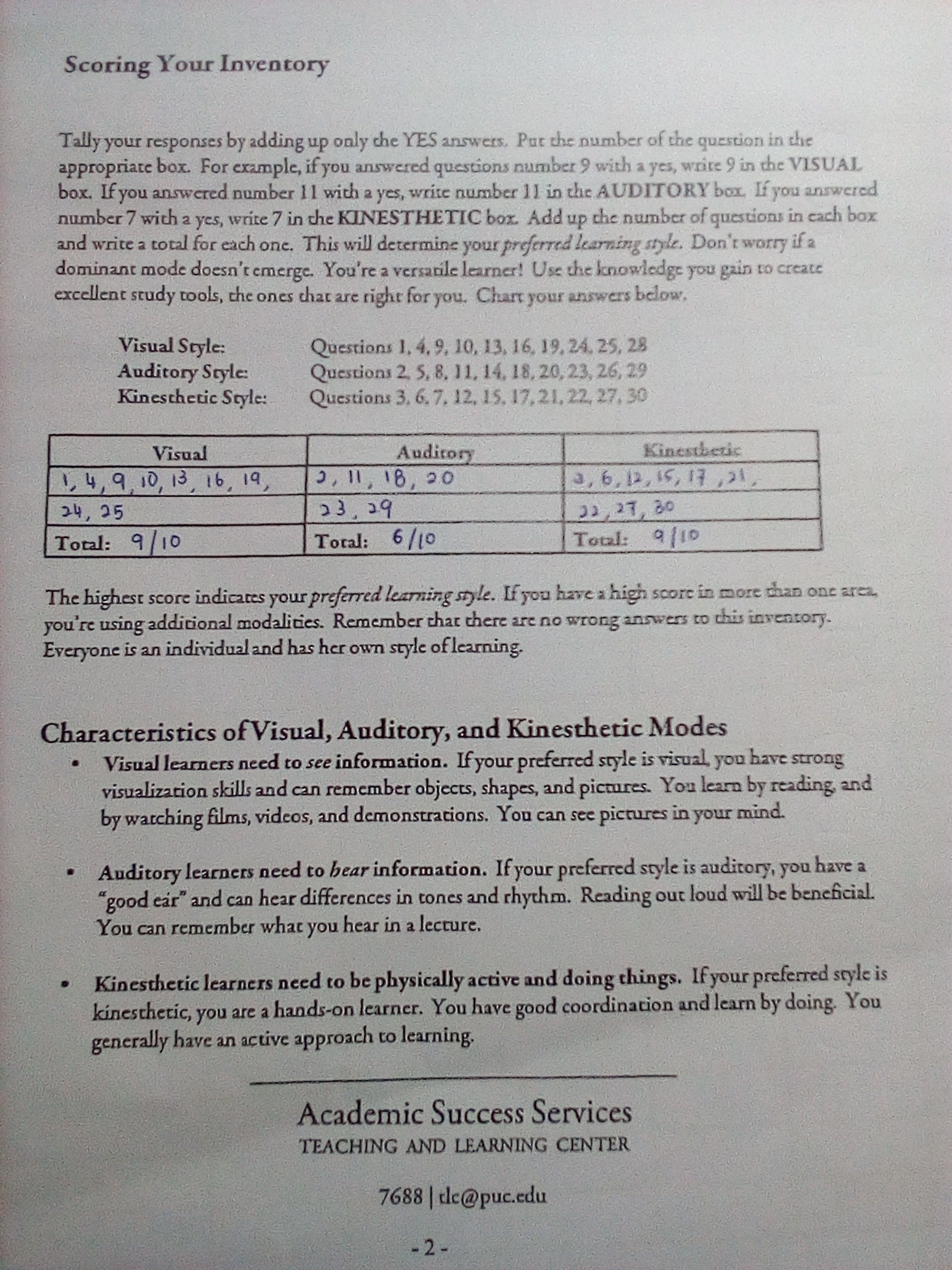
There are three types of learning styles. That is visual , auditory , and kinesthetic.
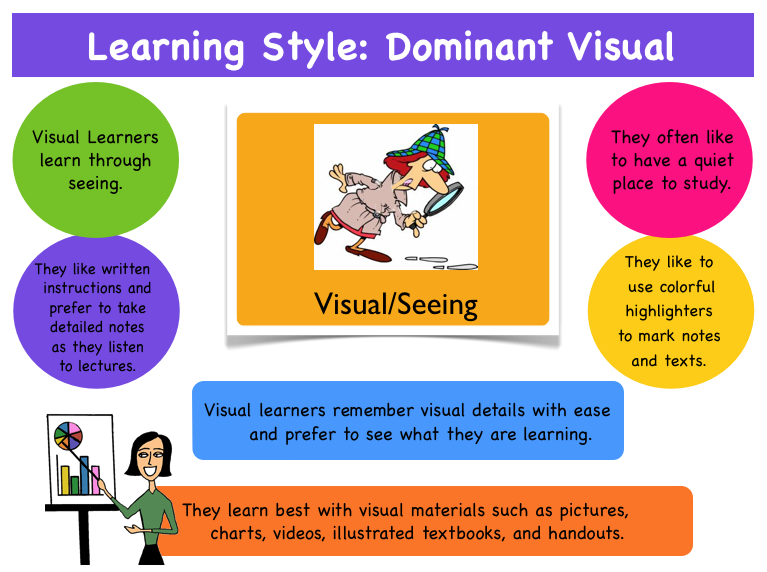
VISUAL TYPES
Visual learners prefer to see info and visualize the relationships between ideas. Basically, the visual learning style means that people need to see information to learn it, and this seeing takes many forms from spatial awareness, photographic memory, colour/tone, brightness/contrast, and other visual information.
Here are just a few of strengths of this learning type:
Instinctively follows directions
Easily visualizes objects
Has a great sense of balance and alignment.
Is an excellent organizer.
Has a strong sense of colour, and is very colour-oriented
AUDITORY TYPES
Auditory learning is a learning style in which a person learns through listening. An auditory learner depends on listening and speaking as a main way of learning. Characteristics of auditory learners is they talk about what to do, about the pros and sons of situation. They indicate emotion through the tone, pitch, and volume of their voices. They also use their listening and repeating skills to sort through the information that is sent to them.
KINESTHETIC TYPES
Kinesthetic learning is a learning style in which learning takes place by the students carrying out physical activities, rather than listening to a lecture or watching demonstration. Kinesthetic learners need to move. they wiggle, tap, swing their leg, bounce, and often just can’t seem to sit still. They learn through their bodies and their sense of touch.
ACTIVITY 2- MY LEARNING STYLE.
By the scoring inventory that I have answered from the question above, it’s showed that I have balanced at visual and kinesthetic learning mode. But i was dominant in characteristic of visual mode. So what should I do if I want to get a maximum out put from my study ? . Here are some tips on how to study for visual learner .
If you’re a visual learner, try these techniques to improve your comprehension, retention, and concentration while studying:
1.Ask for demonstration. Visual learners need to see how something is done.
2. Request handouts. Before class begins, ask the teacher if there is a handout you can review during the lecture. Handouts will help you keep track of the information being presented in the lecture.
3. Incorporate white space in your notes. White space is important for visual learners. When too much information is crammed together, it becomes difficult to read. Think of white space as an organizational tool like any other use it to separate information in your notes.
4.Draw symbols and pictures. Use symbols like exclamation points (for important information) , question marks ( for information that’s confusing or that you need to study further) and stars (for information you understand fully).
5. Make outlines. Outlines are an excellent organizational tool for the visual learner. In an outline, you can structure a large amount of information using heading, subheadings, and bullet points.
..
8 step to college success
Attend all classes – that is the best ways to become successful students because all the information we can get from the lecturer in a class .
Identify sources– know the campus resources that are available to you before you need them
Start Early– whether it is assignment, registering visiting an adviser, or visiting the tutor center, go early.
Become an active leaner – taking a note during the lecture and give lecturer some feedback with ask a question to them.
Participate in university activity. – join all the college activities to become an active person.
Get to know your lectures. – as a students we must know our teacher or lecturer especially their name .
Form study group – study in a group can help us more understand because we can do a discussion to share some ideas from the subject that we have learn.
Work hard every semester. -do not give up till the end .
..
TOPIC 2- GOAL SETTING….
What are goals?
Goal are higher things we want to achieve, thing we aim for as we pursue a certain course of action.
academic performance in college can be improved by learning to set goals that motivate you to do well and that increase your chance to success.
What is goal setting ?
Goal setting is the process of identifying something that you want to accomplish and establishing measurable goal and timeframes.
ACADEMIC GOALS.
Pass an exam with flying colors.
Achieving 4.0 CGPA every semester.
Achieving Dean List for every semester.
Attending all class that required.
Finished all assignment early / on time.
Completing my diploma without any failed.
Graduating on time.
PERSONAL GOALS.
Having a good job with a good pay.
Making my parents proud of me.
Having my own business.
Having big house with a lot of luxury cars.
Travel every year with family and friends.
Giving my parents a lot of joy and happiness.
Can help people in need.
ACTIVITY 3- GOAL STATEMENTS
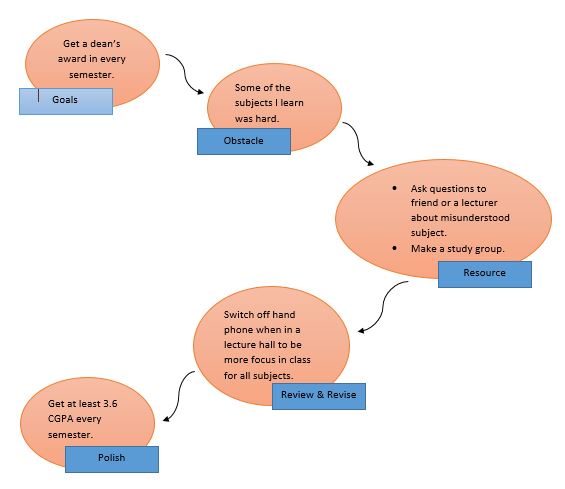
THE FIVE STEP APPROACH.
STEP 1 : Write down what you want to accomplish.
STEP 2: Write down any obstacle.
STEP 3: Write down any resources available for you.
STEP 4: Review and revise your tentative goal statement.
STEP 5: Polish your goal statement.
Tentative Goal Statement.
List Of Obstacle.
List of Resources.
Review and Revise Goal Statement.
Polished Goal Statement.
TENTATIVE GOAL STATEMENT.
4.0 CGPA every semester.
Pass exam with flying colors.
Get a dean’s award every semester.
Finished every assignments on time.
Wake up earlier in the morning.
LIST OF OBSTACLES.
Some of the subjects I learn are hard.
Sleepy in class.
Not focus during class.
Watching movie at night .
Lazy to wake up earlier in the morning.
LIST OF RESOURCES.
Always ask questions to friends or lecturer about a misunderstood subject.
Sleep earlier at night to get fresh body during the class.
Take breakfast every day before go to class to more focus.
Do assignment with friend in group.
Set a timetable for socializing activities.
REVISE GOAL STATEMENT.
Try to get straight A’s in every semester.
Achieve 3.5 and above GPA every semester.
Be an active students.
Switch off hand phone when in lecture hall.
Do the assignment earlier and no procrastinate.
POLISHED GOAL STATEMENT.
Get at least 3.6 CGPA every semester.
Aim to be top students every semester.
Aim to get involve at any lecture activity.
Aim to get first class result in Diploma.
..
TOPIC 3- Time management & organizational skills.
Use strategies for managing time effectively as a college students.
Understand and apply strategies for taking notes efficiently.
Determine the specific time-management , study, and note taking strategies that work best for you individually.
As a student we must know how to manage our time effectively and be more organize person. If you want to success in life you must believe in yourself first. Start with self awareness and strategized. You must know what your aim and goal do you want to achieve in life.
THERE ARE FIVE WAYS TO MANAGE OUR TIME.
Weekly Schedule.
Daily Planner.
Semester Calender.
Balance academic with social and persinal demand.
Avoid Procrastination.
Procrastinate?
Procrastination is a delay or postpone action / putting off a task for another occasion.
COMMON REASONS WHY PEOPLE PROCRASTINATE.
Absence of structure.
Lake of info.
Perfectionist.
Overwhelming task.
Unclear Goals.
Timing.
Lazy.
WAYS TO OVERCOME PROCRASTINATION.
Know what you should accomplish.
Determine deadlines.
Use schedule / planners / calendars.
Be Realistic.
Get a right partner.
Do the unpleasant task first.
Have fun with the activity.
ADVANTAGE OF BEING ORGANIZED.
Reduces Stress.
Increase productivity.
Stick to goals.
Avoid overlapping assignment.
Complete work with less pressure.
..
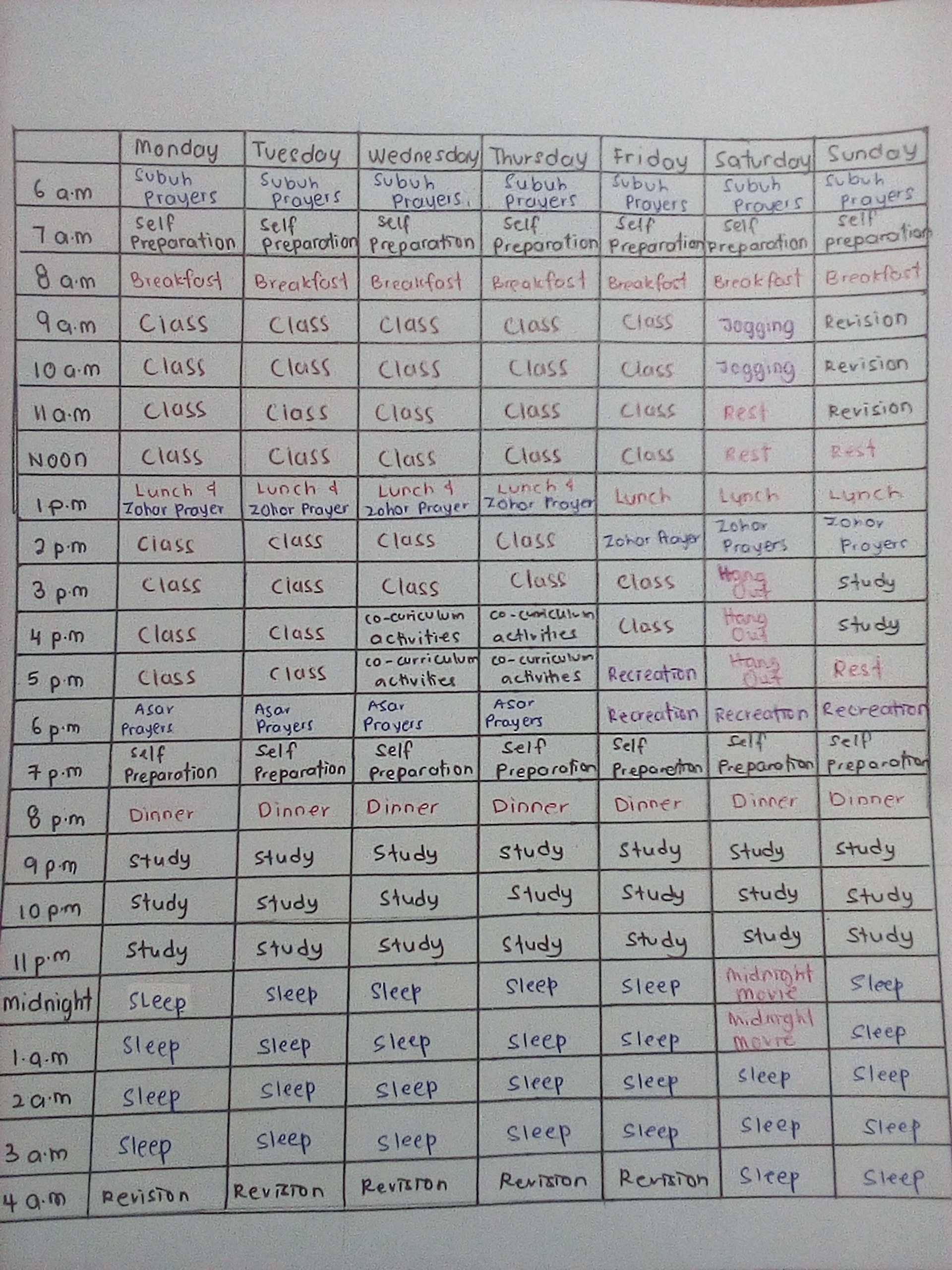
ACTIVITY 4- fixed commitment calendar.
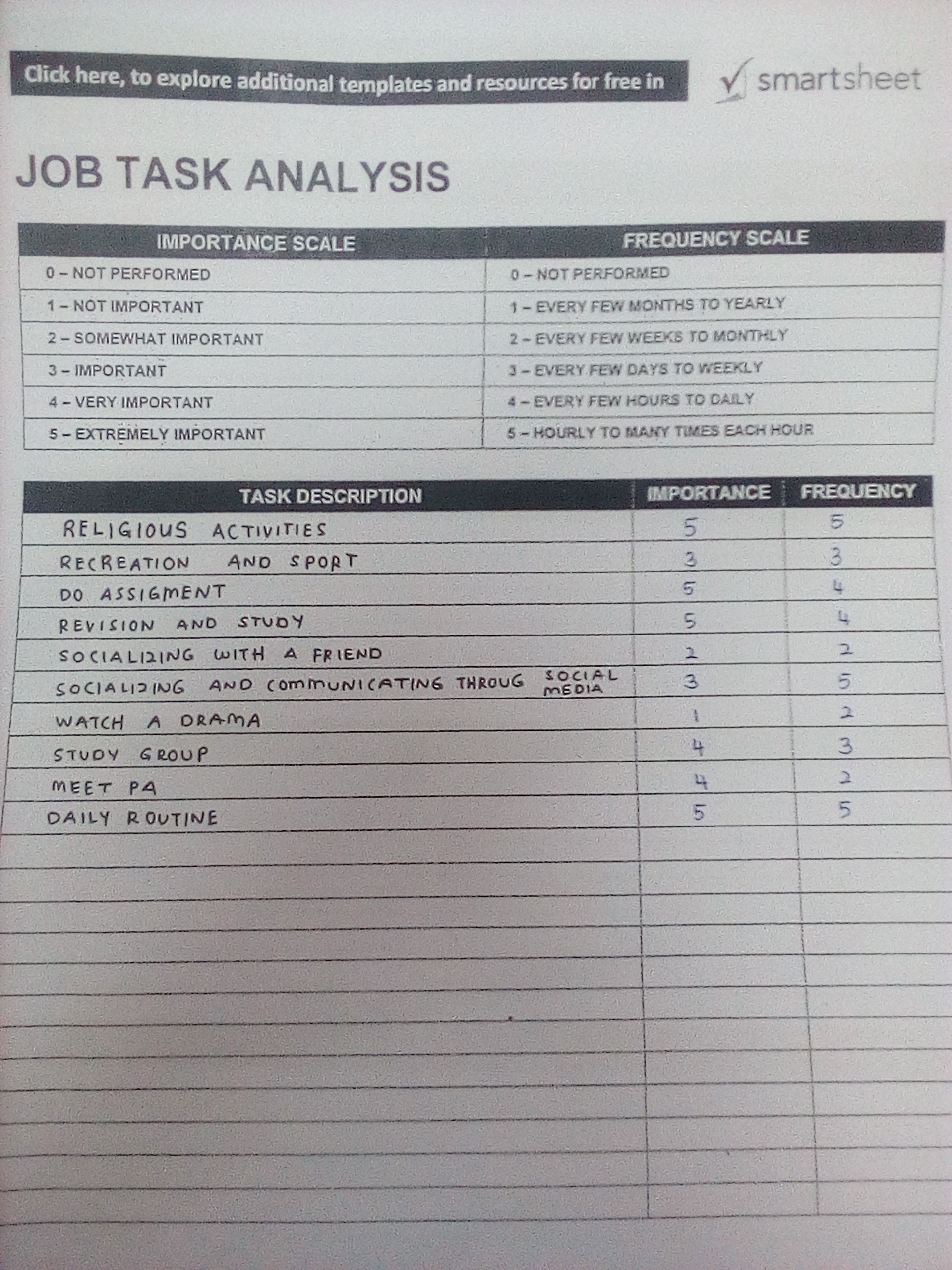
activity 5- job task analysis.
ACTIVITY 6- prioritized to do list
HIGH PRIORITY TASK
DATE DUE
/
FINISHED THE UED 102 PORTFOLIO ASSIGNMENT.
16/8/19
/
GO TO LIBRARY FOR GROUP DISCUSSION.
10/8/19
/
CAMPUS TOUR WITH GROUP FOR VIDEO ASSIGNMENT.
15/8/19
/
SEND ALL DOCUMENT TO SRK, UNIT KESIHATAN AND HEA/HEP.
12/8/19
MEDIUM PRIORITY TASK
DATE DUE
/
BUY THE BUS TICKET BEFORE 2 WEEKS BREAK AFTER INTERIM SEASONS.
16/8/19
/
GO TO SHOPPING COMPLEX TO BUY SOME DAILY NECESSITIES.
15/8/19
/
PAY SUPRO SHIRT AT UNIT SUKAN.
9/8/19
..
TOPIC 4- MEMORY,LEARNING AND CONCENTRATION.
PART OF BRAIN.
ANALOGY OF COMPUTERS.
Encoding/input (keyboard) – Human 5 sense : EAR , MOUTH , NOSE , SKIN , EYES
Storage ( Hard Disk) – Human 3 types of memory : Sensory Memory , Short-term Memory , Long-term Memory.
Retrieval/Output (printer) – Human Writing , Talking .
MEMORY STRATEGIES.
WHAT IS MEMORY ?
In my opinion, memory is something that we keep in our mind from what we learn and saved from our experience . The human memory system is divided into three types . 1. sensory memory , 2. short-term memory , 3. long-term memory. Majority of the students facing problems to memorize anything that they learn. Is not impossible to memorize everything . It is not mean that their memory is weak or they are stupid but it must be because they have no strategy in memorizing. It is no impossible for us to memorize from what have we learn but we must know a memorable way that works for us. For example, we can isolate all the content by its category, make acronyms or any ways. Here is the example of the acronyms that I have used to remember all the cation from the chemistry subject.
cation
kalau -kalium
nak -natrium
kawin -kalsium
mesti -magnesium
ada -aluminium
zakat -zink
fitrah -ferum ii
supaya -stanum
perkahwinan -plumbum
hingga -hidrogen
cucu -kuprum ii
anak. -argentum
3 TYPES OF MEMORY.
1.SENSORY MEMORY. – It acts as kind of buffer for stimuli receive through the five senses of sight, hearing, smell, taste, and touch. Sensory memory is the shortest-term element of memory. But you must pay attention to the stimuli . If you not pay attention it would not be last long and may lost .
2.SHORT-TERM MEMORY. – Short-term memory is the capacity to keep a small amount of information. It was very brief . When you are not rehearsed or actively maintained, they last mere second.
3.LONG-TERM MEMORY. – The long-term memory refers to the unlimited capacity memory store that can hold information over lengthy period of time. But if the information is not being used for a long time . The information will be lost.
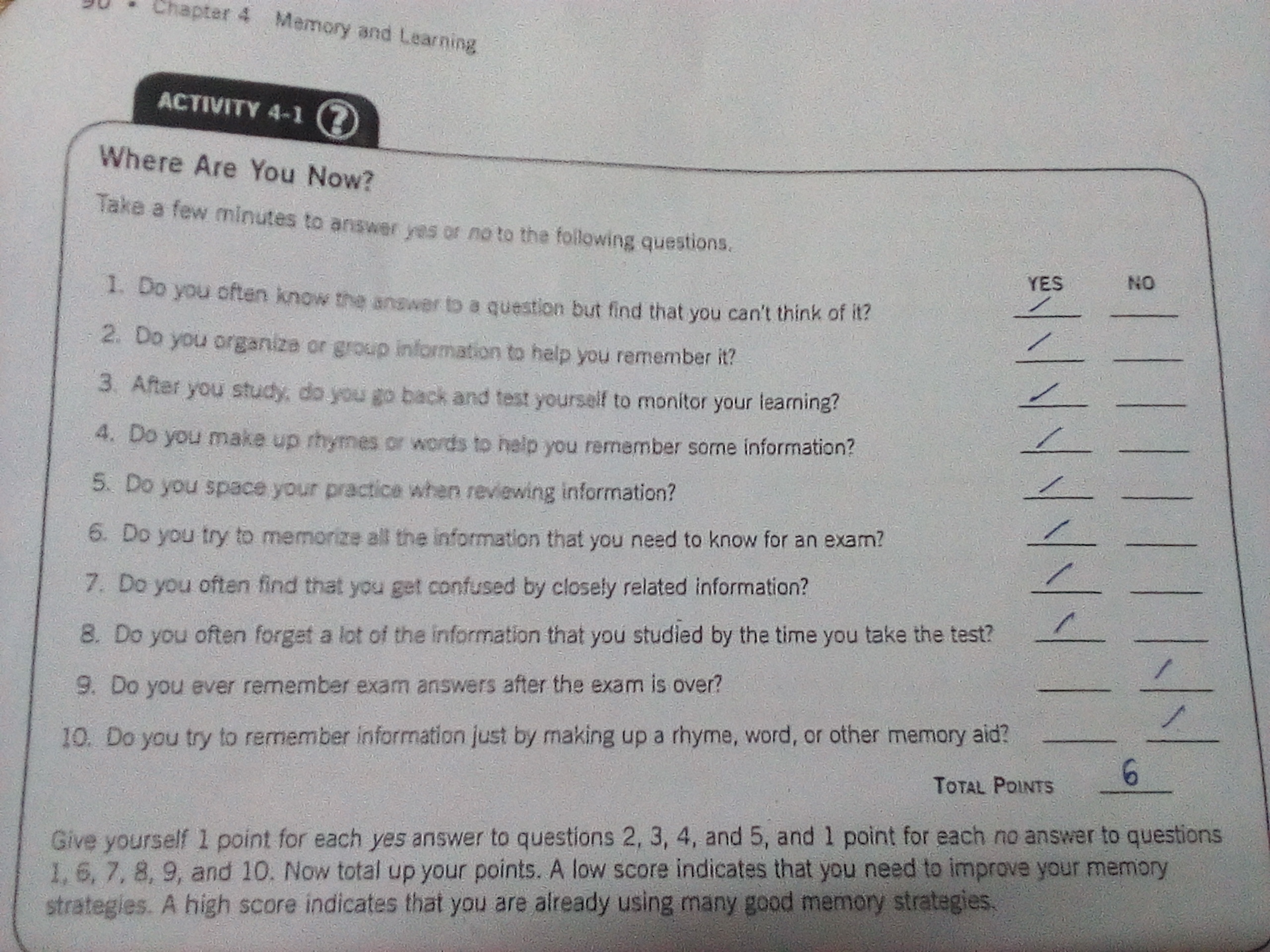
ACTIVITY 7 – MEMORY AND LEARNING 4.1.
causes of forgetting .
Weak of strategy for memorizing .
Did not pay attention.
Interference (having two subject in same time)
Not enough rest and sleep.
Lack of revision.
Did not take a note when the information was given.
MEMORY STRATEGY
Give fully attention .
Get enough sleep.
Take a note to all information given.
Repeat the information many times.
Avoid cramming .
elaboration strategies , Make association, imagery and acronyms to memorize easily. (e.g : GST – government service text)
Read Quran .
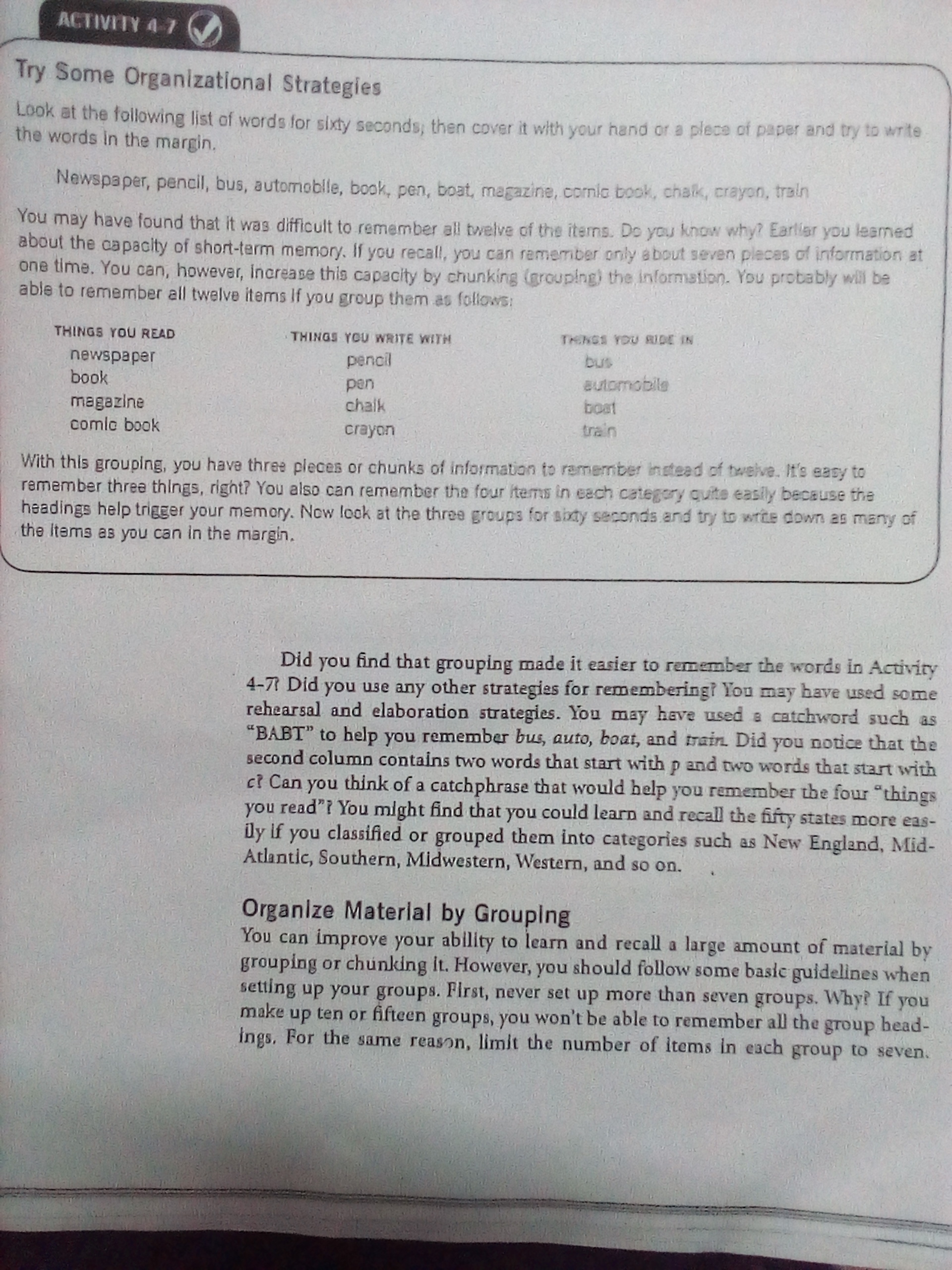
activity 8 – ORGANIZATIONAL STRATEGY 4.7
concentration .
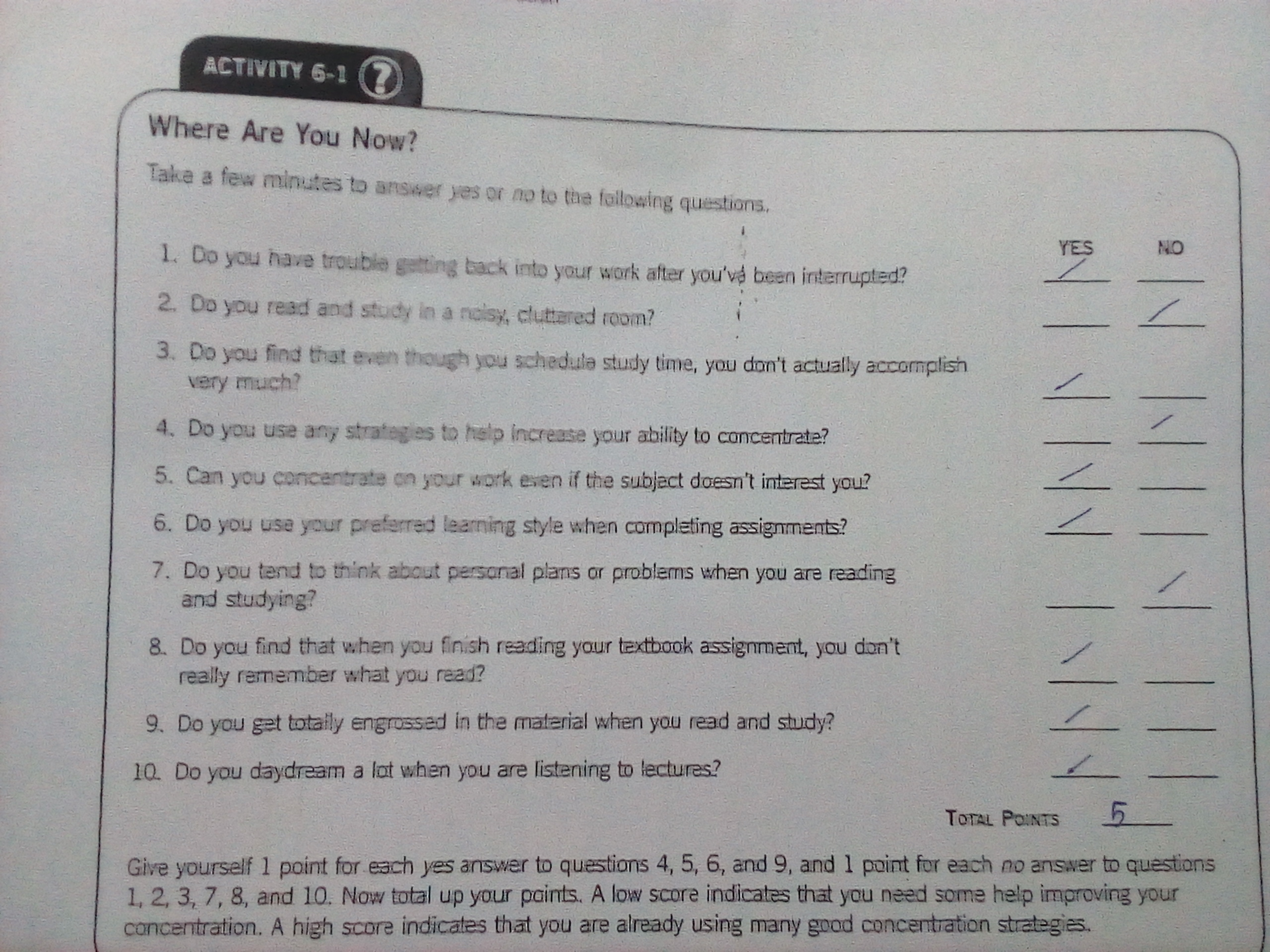
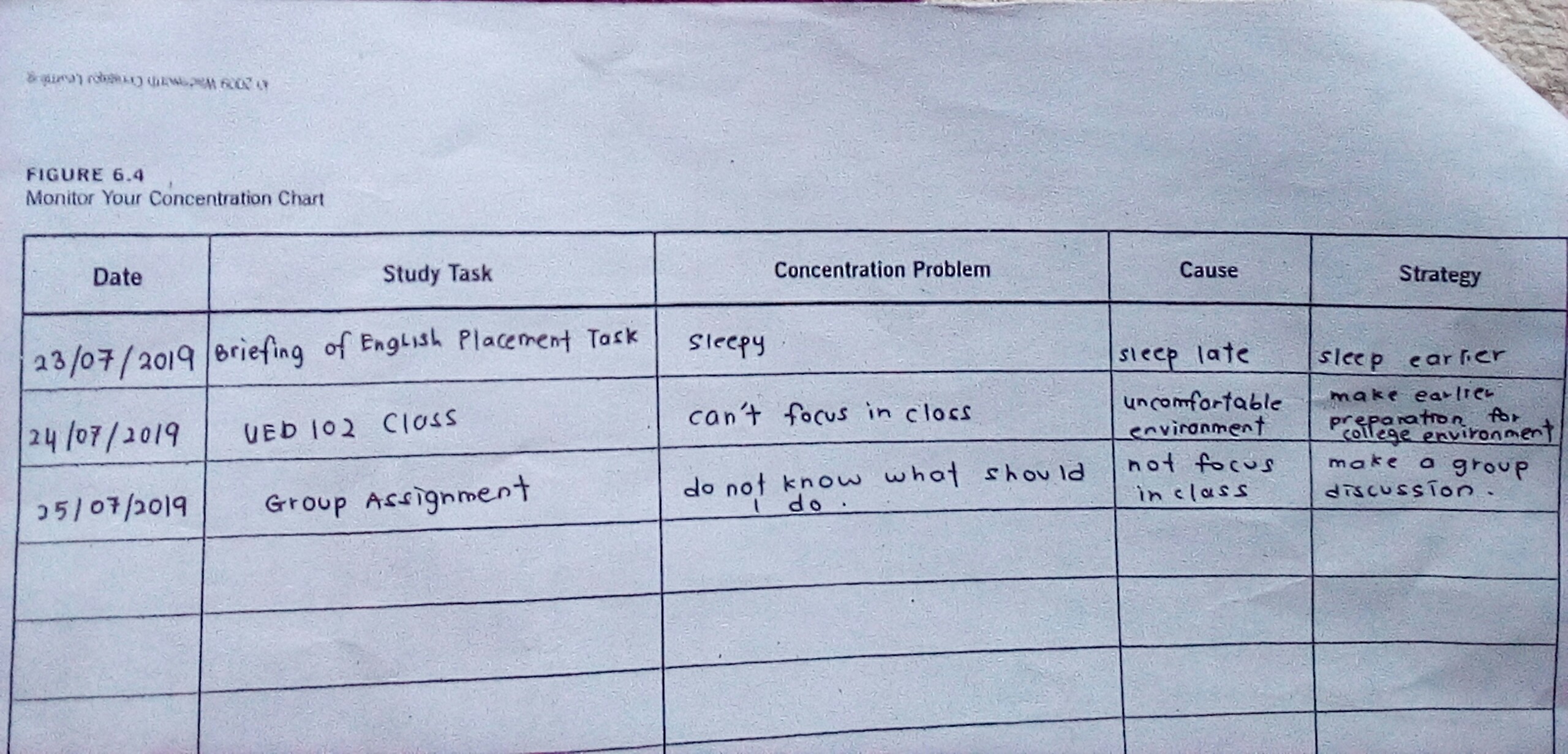
ACTIVITY 8- CONCENTRATION STRATEGIES 6.1
From the activity above, we know on how we get more concentration on something we did.
WHAT IS CONCENTRATION ?
Focusing your attention on what you are doing to get all the information .
CAUSES OF POOR CONCENTRATION.
Sleepy in class .
Lack of information.
Uncomfortable Environment.
Did not focus during the class.
Lack of interesting.
Have a lot of personal problem.
Strategies to improve concentration.
Get sufficient sleep.
Fix your interest to all subjects.
Meet a counselor to solve your personal problem.
Develop a healthy lifestyle.
ACTIVITY 9- CONCENTRATION CHART 6.4.
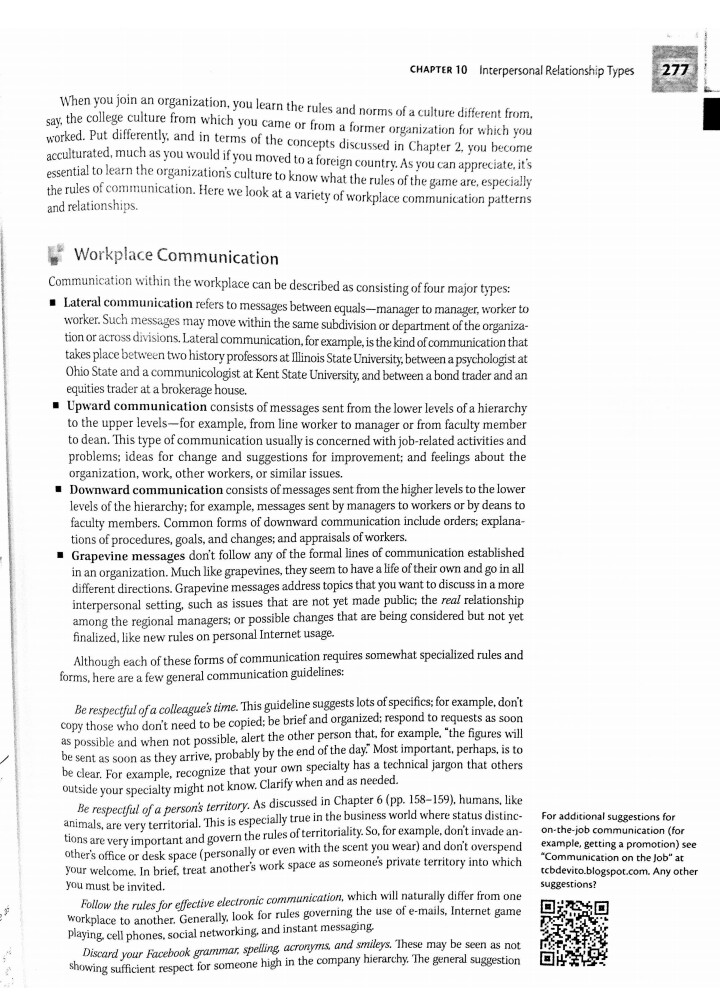
ACTIVITY 10-READING TEXT.
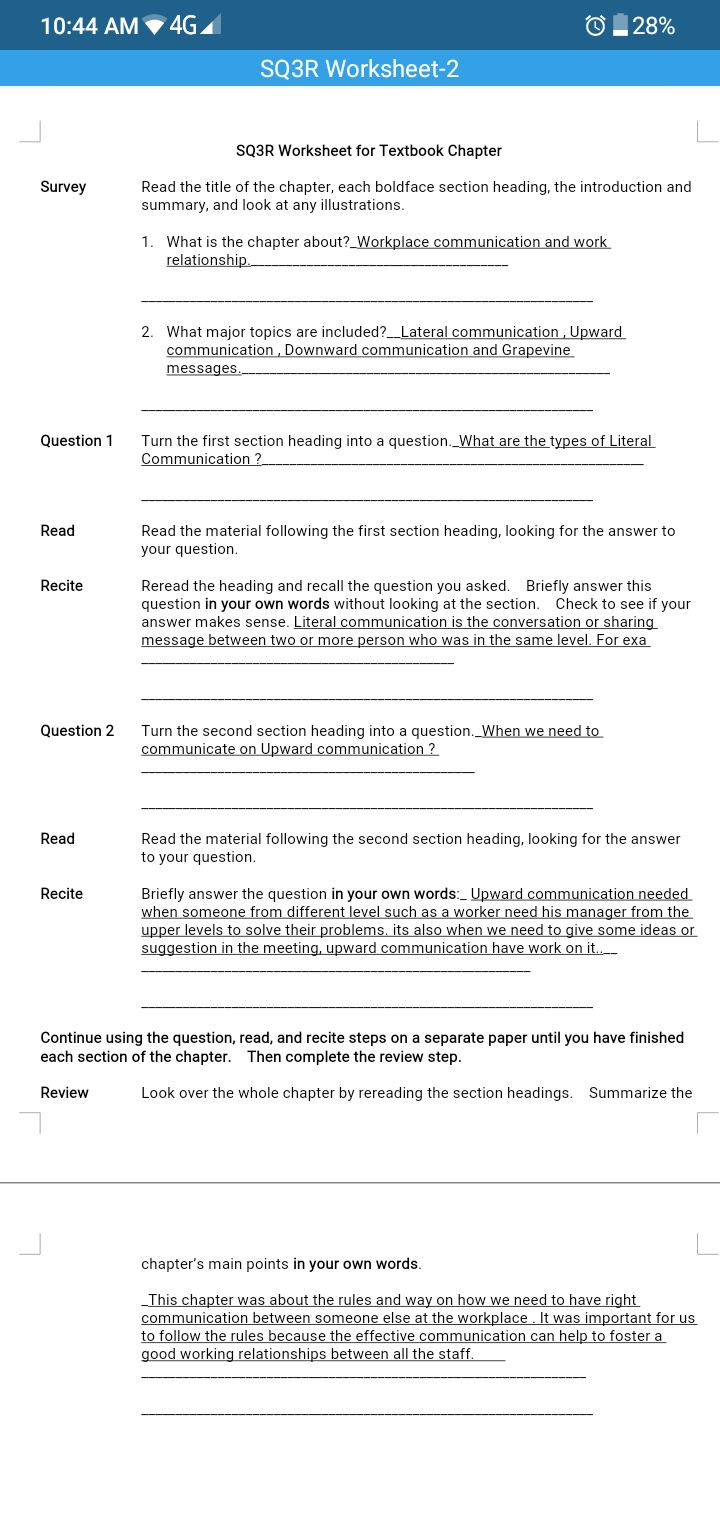
SQ3R..
SURVEY – Look at all the reading text given either from the heading, sub-heading, first paragraph, last paragraph or from the image and diagram.
QUESTION – Based on the text you have read, ask any question are relate to a topic . Use a question marks to all your question. [when?, what?, where?, how?, who?]
READ – Read all the text from first paragraph till last paragraph to look for the keyword and important content.
RECITE – Recite the information out loud and repeat for a few times to understand the content.
REVIEW – Review the information daily or weekly to memorize the text about. Recall the text to answer the question properly.
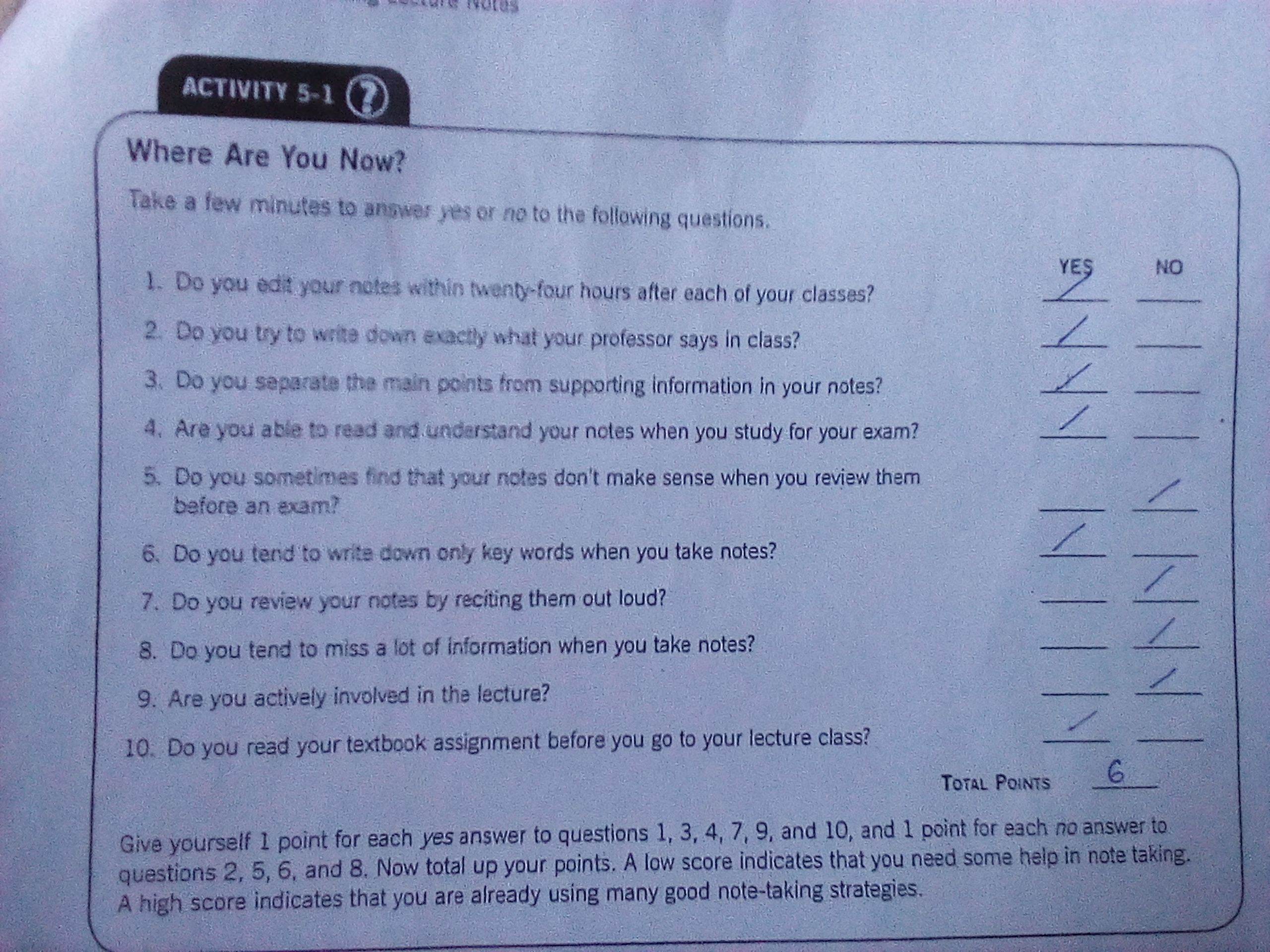
topic 5- taking lecture notes.
What is taking notes?
Taking note is writing down what we have learn in a few ways as simple as possible. You can take a note through write the keywords, points or in a story board. Taking notes will help you memorize and more understands about what you have learn.
Benefits of taking notes.
Ways of understanding is easier . – By taking a notes during a lecture and class it can help us more understanding.
Quick to revise . – It becomes easier to remember the topics by the simple notes compared to full text. So the revision before exam get faster.
Likeness the topics. – Since it is yours handwriting and notes .there will be a feeling of likeness to the topic than read from the text book. Plus how the notes decorate by you it can make you more interesting on your note to read.
ACTIVITY 11. – NOTE TAKING STRATEGIES 5.1
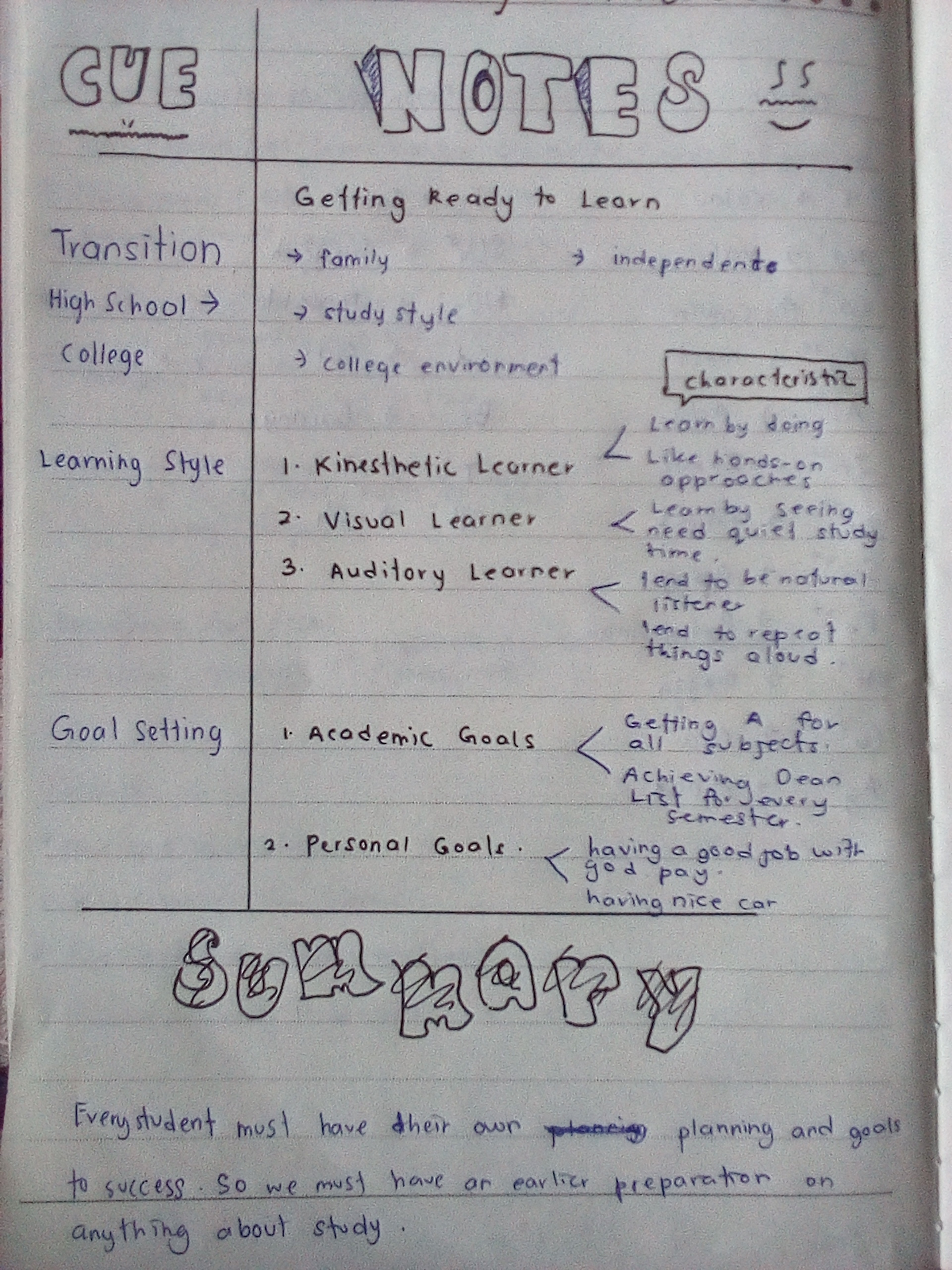
the cornell method.
The cornell note-taking system has an excellent format for setting up your note page . Use an 8.5 by 11 inch notebook . It has a recall/cue column and a summary column at the end . –
Activity 12. -Note taking cornell method.
topic 6 – academic integrity and performance.
plagiarism
Plagiarism is copying of other people’s work or ideas into your own work.
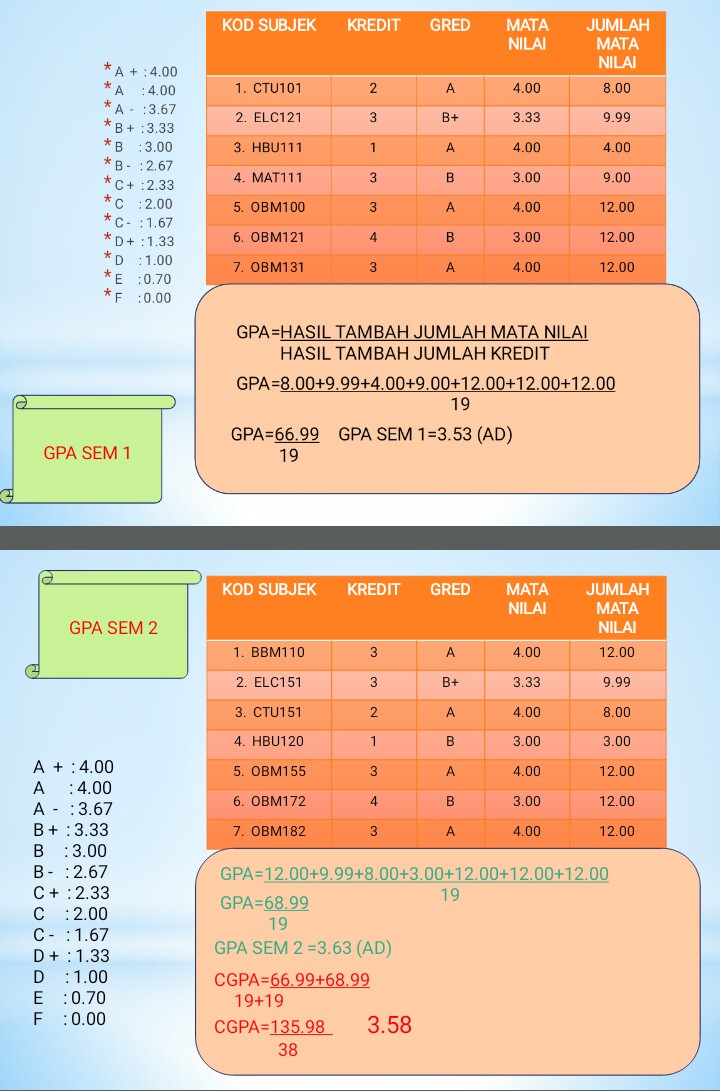
GPA WORKSHEET
From https://www.easycalculation.com/maths-dictionary/cgpa.html . CGPA is defined as Cumulative Grade Points Avarage . CGPA is the measurement of average grade points obtained by a student in all the semester excluding addtional 6th subject as per Scheme of studies.